
ISHIK2024
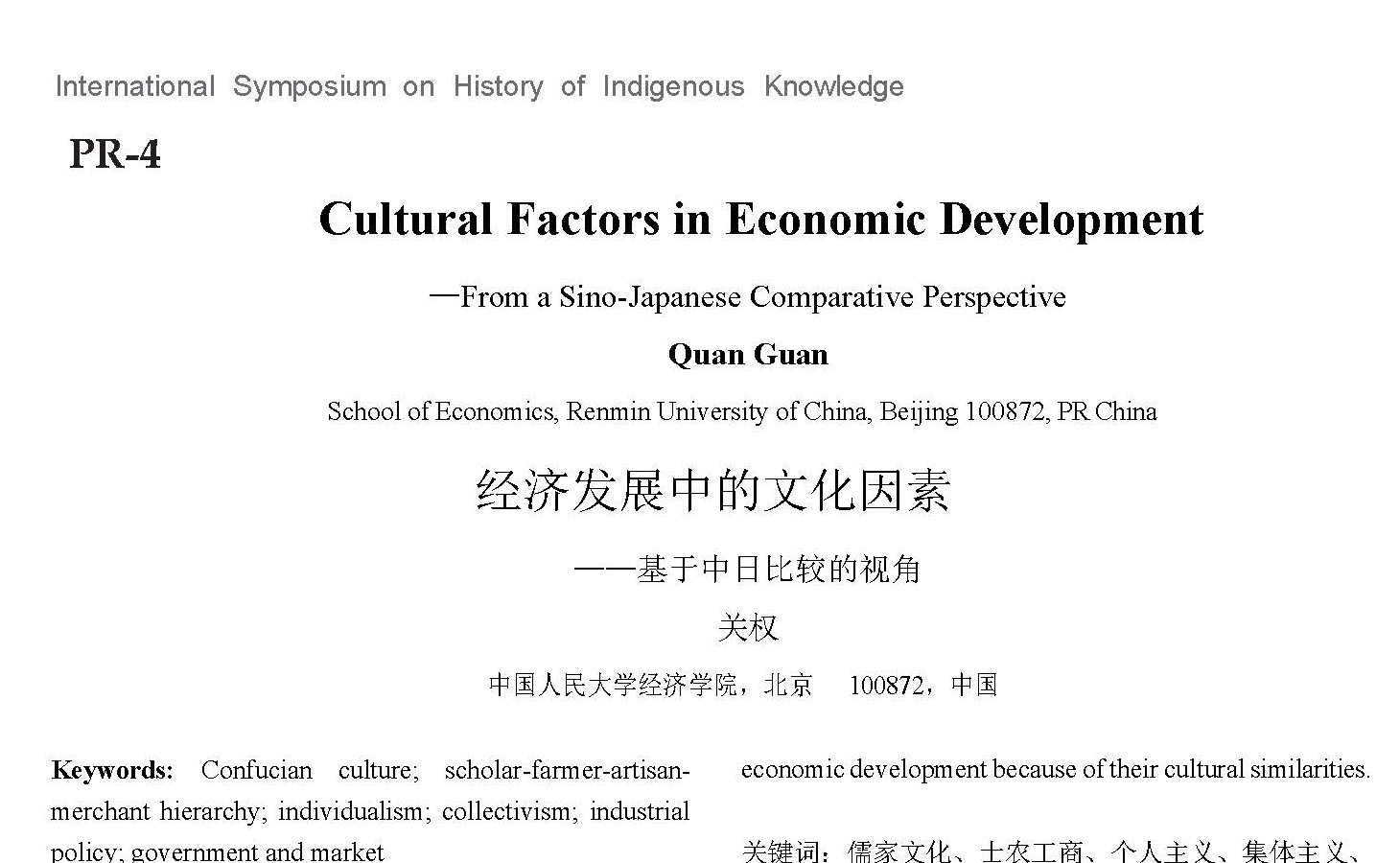
Title:Cultural Factors in Economic Development -From a Sino-Japanese Comparative Perspective
発表者:关权 (Quan Guan)
所属:中国人民大学经济学院,北京 100872,中国 (中国人民大学经济学院,北京 100872,中国)
キーワード:儒家文化, 士农工商, 个人主义, 集体主义, 产业政策, 政府与市场
Keywords:Confucian culture, scholar-farmer-artisan-merchant hierarchy, individualism, collectivism, industrial policy, government and market
要旨:
本文研究文化与经济发展关系以及对经济发展的作用。就目前而言,从这个角度研究经济发展的学术成果很少,我们在这里做一些探索性研究。观察各国经济发展的状况可知,已经发展起来或者正在快速发展的国家和地区,主要集中于西欧、北欧、北美、大洋洲、东亚、东南亚,而这些地区从文化上看主要是基督教新教和儒家文化圈。因此,我们认为经济发展与文化具有一定的关联性。然而,文化并不是直接促进经济发展的因素,而是基础因素,需要进行深入研究。本文首先对文化如何作用于经济发展做了一些探索性考察,将其分为个人和政府(制度)两个部分,最后都归结为市场形态。 然后,对通过几个文化侧面比较了中国与日本的相似性和相异性。进一步,考察了几个经济发展的侧面,如产业政策、政府的作用。通过比较,我们得出中日两国由于在文化上存在相似性,从而在经济发展过程中体现了相似的特征。
Abstract:
This paper studies the relationship between culture and economic development and its role in economic development. For now, there are few academic achievements on economic development from this perspective, so we are doing some exploratory research here. Observing the economic development of various countries, we can see that the countries and regions that have developed or are developing rapidly are mainly concentrated in Western Europe, Northern Europe, North America, Oceania, East Asia, Southeast Asia, and these regions are mainly Protestant and Confucian cultural circles from the cultural point of view. Therefore, we believe that economic development has a certain correlation with culture. However, culture is not a factor that directly promotes economic development, but a fundamental factor that needs to be studied in depth. This paper first makes some exploratory investigation on how culture influences economic development, divides it into two parts: individual and government (system), and finally boils down to market form. Then, the similarities and differences between China and Japan are compared through several cultural aspects. Further, it examines several aspects of economic development, such as industrial policy, and the role of government. By comparison, we conclude that China and Japan have similar characteristics in the process of economic development because of their cultural similarities.